Publications by topic
| concepts | indeterminate sentences ('coercion') | verb structure and meaning | metaphors | language-vision interface | semantic deficits (Alzheimer's) | morphology in word recognition | other |
Concepts
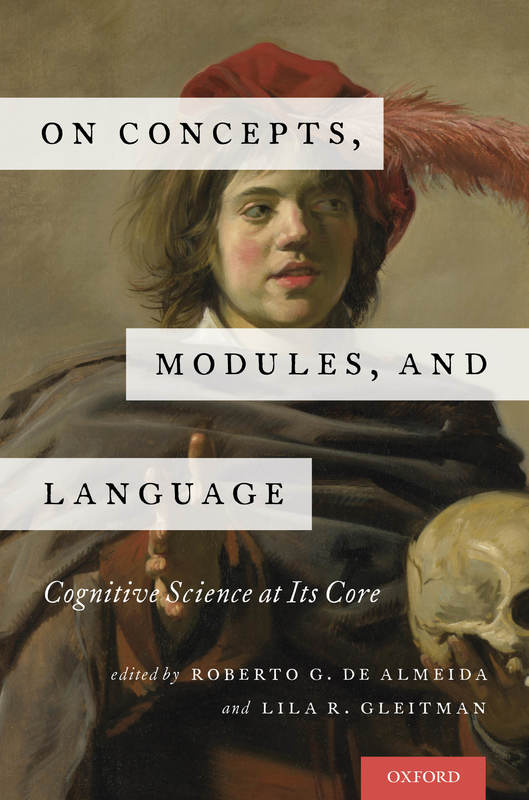
de Almeida, R. G. & Gleitman, L. (Eds.) (2018). On Concepts, Modules, and Language: Cognitive Science at its Core. Oxford University Press. [link to Oxford]
Antal., C. & de Almeida, R. G. (2024, Submitted). Grasping the concept of an object at a glance: Category information accessed by brief dichoptic presentation.
Antal., C., Johns, B. T., & de Almeida, R. G. (2024, Submitted). The effect of contextual and semantic diversity in lexical and conceptual access: Evidence from a picture-word semantic congruency task.
Antal., C. & de Almeida, R. G. (2024, Submitted). Grasping the concept of an object at a glance: Category information accessed by brief dichoptic presentation.
Antal., C., Johns, B. T., & de Almeida, R. G. (2024, Submitted). The effect of contextual and semantic diversity in lexical and conceptual access: Evidence from a picture-word semantic congruency task.
- Antal., C., de Almeida, R. G., & Johns, B. T. (2022). Which semantic properties of a feature affect access to an object concept? In J. Culbertson, A. Perfors, H. Rabagliati, & V. Ramenzoni (Eds.), Proceedings of the 44th Annual Conference of the Cognitive Science Society (pp. 2364-2371). Toronto, ON: Cognitive Science Society. (Refereed) [.pdf]
- de Almeida, R. G., Mobayyen, F., Antal, C., Kehayia, E., Nair, V., & Schwartz, G. (2021). Category-specific verb-semantic deficits in Alzheimer’s disease: Evidence from static and dynamic action naming. Cognitive Neuropsychology, 38 (1), 1-26. [.pdf] [link to journal]
- de Almeida, R. G. (2018) A Fodor's guide to Cognitive Science. In de Almeida, R. G. & Gleitman, L. (Eds.) (2018). On Concepts, Modules, and Language: Cognitive Science at its Core. Oxford University Press. [.pdf] [link to book]
- de Almeida, R. G., & Antal, C. (2021). How can semantics avoid the troubles with the analytic/synthetic distinction? In S. Löbner et al. (Eds.) Concepts, Frames and Cascades in Semantics, Cognition and Ontology. New York: Springer. [.pdf] [link to book]
- de Almeida, R. G. (2007). Cognitive science as paradigm of interdisciplinarity: The case of lexical concepts. In J. Audy & M. Morosini (Orgs.). Interdisciplinarity in Science and at the University, pp. 221-247. Porto Alegre: EdiPUCRS. [.pdf]
- Mobayyen, F. & de Almeida, R. G. (2005). The influence of semantic and morphological complexity of verbs on sentence recall: Implications for the nature of conceptual representation and category-specific deficits. Brain and Cognition, 57, 168-175. [ .pdf]
- Segalowitz, N. & de Almeida, R. G. (2002). Conceptual representation of verbs in bilinguals: Semantic field effects and a second language performance paradox. Brain and Language, 81, 517-531. [.pdf]
- de Almeida, R. G. (2001). Conceptual deficits without features: A view from atomism. Behavioral and Brain Sciences, 24(3): 482-483. [.pdf]
- de Almeida, R. G. (1999). What do category-specific semantic deficits tell us about the representation of lexical concepts? Brain and Language, 68, 241-248. [.pdf]
Indeterminate sentences (a.k.a. 'coercion' phenomenon)
- Antal, C., & de Almeida, R. G. (2021). Indeterminate and enriched propositions in context linger: Evidence from an eye-tracking false memory paradigm. Frontiers in Psychology, 4376(12), 1-9 [link to article]
- Riven, L., & de Almeida, R. G. (2021). Context breeds false memories for indeterminate sentences. Frontiers in Psychology 12:616065. doi: 10.3389/fpsyg.2021.616065 [link to article]
- de Almeida, R. G., & Antal, C. (2021). How can semantics avoid the troubles with the analytic/synthetic distinction? In S. Löbner et al. (Eds.) Concepts, Frames and Cascades in Semantics, Cognition and Ontology. New York: Springer. [.pdf] [book]
- de Almeida, R. G. & Lepore, E. (2018). Semantics for a module. [.pdf] [link to book]
- de Almeida, R. G. (2018) Composing meaning and thinking. In G. Preyer (ed.) Beyond Semantics and Pragmatics. Oxford University Press. [.pdf] [link to book]
- de Almeida, R. G., Riven, L., Manouilidou, C., Lungu, O., Dwivedi, V., Jarema, G., & Gillon, B. (2016). The neuronal correlates of indeterminate sentence interpretation: an fMRI study. Frontiers in Human Neuroscience 10:614. [link to article]
- de Almeida, R. G. & Riven, L. (2012). Indeterminacy and coercion effects: Minimal representations with pragmatic enrichment. In DiSciullo, A.M. (Ed), Towards a Biolinguistic Understanding of Grammar (pp. 277-301). Amsterdam: John Benjamins. [.pdf]
- de Almeida, R. G., Manouilidou, C., Roncero, C., & Riven, L. (2011). Three tales of semantic decomposition: Causatives, coercion, and metaphors. In A. I. França & M. Maia (Eds.) Papers in Psycholinguistics (pp. 172-190). Rio de Janeiro: Imprint. [uncorrected proofs | .pdf]
- Leitão, M. M., Gadelha, L., & de Almeida, R. G. (2011). Looking for coercion effects in Brazilian Portuguese. In A. I. França & M. Maia (Eds.) Papers in Psycholinguistics (pp. 151-156). Rio de Janeiro: Imprint. [uncorrected proofs | .pdf]
- de Almeida, R. G. & Dwivedi, V. D. (2008). Coercion without lexical decomposition: Type-shifting effects revisited. Canadian Journal of Linguistics, 53, 301-326. [ .pdf]
Verb structure and meaning
- de Almeida, R. G., Mobayyen, F., Antal, C., Kehayia, E., Nair, V., & Schwartz, G. (2021). Category-specific verb-semantic deficits in Alzheimer’s disease: Evidence from static and dynamic action naming. Cognitive Neuropsychology, 38 (1), 1-26. [.pdf] [link to journal]
- de Almeida, R. G., & Antal, C. (2021). How can semantics avoid the troubles with the analytic/synthetic distinction? In S. Löbner et al. (Eds.) Concepts, Frames and Cascades in Semantics, Cognition and Ontology. New York: Springer. [.pdf] [book]
- de Almeida, R. G., Di Nardo, J., Antal, C., & von Grünau, M.W. (2019). Understanding events by eye and ear: Agent and verb drive non-anticipatory eye movements in dynamic scenes. Frontiers in Psychology, 10:2162 [link to article]
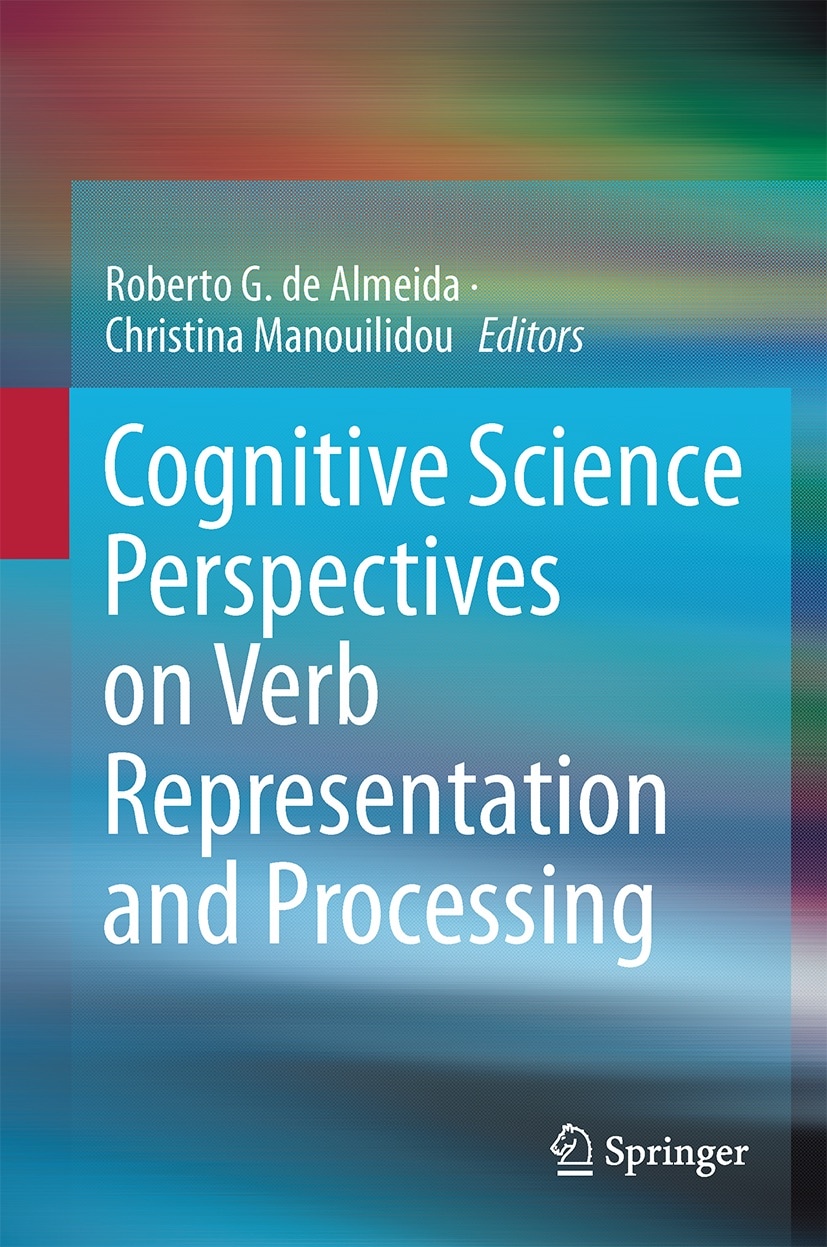
- de Almeida, R. G. & Manouilidou, C. (Eds.) (2015). Cognitive Science Perspectives on Verb Representation and Processing. New York: Springer. [link to Springer]
- Review in the journal Aphasiology
- de Almeida, R. G. & Manouilidou, C. (2015). The study of verbs in cognitive science. In R. G. de Almeida & C. Manouilidou (Eds.), Cognitive Science Perspectives on Verb Representation and Processing. New York: Springer. [.pdf] [link to article] [link to book]
- de Almeida, R. G. & Antal, C. (2016). Category-specific verb deficits in Alzheimer's: Argument structure effects in naming and sentence production with dynamic scenes. Poster presented at the Society for the Neurobiology of Language annual conference. London, August. [poster][paper draft]
- Ibaños, A. M. & de Almeida, R. G. (Eds.) (2016). Tense, Aspect, Mood, and Evidentiality. Special issue of the journal Letras de Hoje. http://dx.doi.org/10.15448/1984-7726.2016.3
- Manouilidou, C. & de Almeida, R. G. (2013). Processing correlates of verb typology: Investigating internal structure and argument realization. Linguistics, 51 (4), 767-792. [uncorrected proofs | .pdf]
- de Almeida, R. G., Manouilidou, C., Roncero, C., & Riven, L. (2011). Three tales of semantic decomposition: Causatives, coercion, and metaphors. In A. I. França & M. Maia (Eds.) Papers in Psycholinguistics (pp. 172-190). Rio de Janeiro: Imprint. [uncorrected proofs | .pdf]
- Manouilidou, C. & de Almeida, R. G. (2009) Canonicity in argument realization and verb semantic deficits in Alzheimer’s disease. In S. Featherston & S. Winkler (eds.). The Fruits of Empirical Linguistics, vol. 1: Process. (pp. 123-150). Berlin: Mouton De Gruyter. [.pdf]
- Manouilidou, C., de Almeida, R. G., Schwartz, G., & Nair, V. (2009). Thematic roles in Alzheimer’s disease: Hierarchy violations in psychological predicates. Journal of Neurolinguistics, 22, 167-186. [.pdf]
- Mobayyen, F. & de Almeida, R. G. (2005). The influence of semantic and morphological complexity of verbs on sentence recall: Implications for the nature of conceptual representation and category-specific deficits. Brain and Cognition, 57, 168-175. [ .pdf]
- de Almeida, R. G., Madon, Z., van de Velde, C., Di Nardo, J., Godfrey, J., & von Grünau, M. W., (2004). Verb-driven shifts of attention during sentence comprehension and dynamic scene processing. Journal of Vision, 4 (8), 828a. [abstract]
- de Almeida, R. G., van de Velde, C., von Grünau, M. W., & Galera, C. (2003). (Eye-)tracking the time course of visual and linguistic integration: the effect of verb-conceptual restrictions. Journal of Vision, 3 (9), 308a. [abstract]
Metaphors
- Pissani, L. & de Almeida, R. G. (2023). Early birds can fly: Awakening the literal meaning of conventional metaphors further downstream. Metaphor and Symbol [link to article]
- Pissani, L. & de Almeida, R. G. (2021). Can you mend a broken heart? Awakening conventional metaphors in the maze. Psychonomic Bulletin & Review. [.pdf] [link to article]
- Roncero, C., de Almeida, R. G., Pissani, L., & Patalas, I. (2021). A metaphor is not like a simile: reading-time evidence for distinct interpretations for negated tropes. Metaphor and Symbol, 36 (2), 85-98. [.pdf] [link to journal]
- Patalas, I. & de Almeida, R. G. (2019). Interpreting metaphors in real-time: cross-modal evidence for exhaustive access. In In A.K. Goel, C.M. Seifert, & C. Freksa (Eds.), Proceedings of the 41st Annual Conference of the Cognitive Science Society (pp. 2530-2536). Montreal, QC: Cognitive Science Society. [.pdf]
- de Almeida, R. G. (2018) Composing meaning and thinking. In G. Preyer (ed.) Beyond Semantics and Pragmatics. Oxford University Press. [.pdf] [link to book]
- Ashby, J., Roncero, C., de Almeida, R. G., & Agauas, S. (2018). The early processing of metaphors and similes: evidence from eye movements. Quarterly Journal of Experimental Psychology, 71 (1), 161-168. [.pdf] [link to article]
- Roncero, C., de Almeida, R. G., Martin, D., & de Caro, M. (2016). Aptness predicts metaphor preference in the lab and on the Internet. Metaphor & Symbol, 31, 31-46. [.pdf] [link to article]
- Roncero, C., & de Almeida, R. G. (2015). Semantic properties, aptness, familiarity, conventionality, and interpretive diversity scores for 84 metaphors and similes. Behavior Research Methods, 47, 800-812 [.pdf] [link to journal]
- Roncero, C. & de Almeida, R. G. (2014). The importance of being apt: Metaphor comprehension in Alzheimer’s disease. Frontiers in Human Neuroscience, 8 [link to article]
- de Almeida, R. G., Manouilidou, C., Roncero, C., & Riven, L. (2011). Three tales of semantic decomposition: Causatives, coercion, and metaphors. In A. I. França & M. Maia (Eds.) Papers in Psycholinguistics (pp. 172-190). Rio de Janeiro: Imprint. [uncorrected proofs | .pdf]
Language-Vision Interface
- de Almeida, R. G., Di Nardo, J., Antal, C., & von Grünau, M.W. (2019). Understanding events by eye and ear: Agent and verb drive non-anticipatory eye movements in dynamic scenes. Frontiers in Psychology, 10:2162 [link to article]
- de Almeida, R. G., Madon, Z., van de Velde, C., Di Nardo, J., Godfrey, J., & von Grünau, M. W., (2004). Verb-driven shifts of attention during sentence comprehension and dynamic scene processing. Journal of Vision, 4 (8), 828a. [abstract]
- de Almeida, R. G., van de Velde, C., von Grünau, M. W., & Galera, C. (2003). (Eye-)tracking the time course of visual and linguistic integration: the effect of verb-conceptual restrictions. Journal of Vision, 3 (9), 308a. [abstract]
Semantic Deficits (in Alzheimer's and Brain Damaged populations)
- de Almeida, R. G., Mobayyen, F., Antal, C., Kehayia, E., Nair, V., & Schwartz, G. (2021). Category-specific verb-semantic deficits in Alzheimer’s disease: Evidence from static and dynamic action naming. Cognitive Neuropsychology, 38 (1), 1-26. [.pdf] [link to journal]
- de Almeida, R. G. & Antal, C. (2016). Category-specific verb deficits in Alzheimer's: Argument structure effects in naming and sentence production with dynamic scenes. Poster presented at the Society for the Neurobiology of Language annual conference. London, August. [poster]
- Roncero, C. & de Almeida, R. G. (2014). The importance of being apt: Metaphor comprehension in Alzheimer’s disease. Frontiers in Human Neuroscience, 8 [link to article]
- Manouilidou, C. & de Almeida, R. G. (2009) Canonicity in argument realization and verb semantic deficits in Alzheimer’s disease. In S. Featherston & S. Winkler (eds.). Process and Product in Empirical Linguistics (pp. 123-150). Berlin: Mouton De Gruyter. [.pdf]
- Manouilidou, C., de Almeida, R. G., Schwartz, G., & Nair, V. (2009). Thematic roles in Alzheimer’s disease: Hierarchy violations in psychological predicates. Journal of Neurolinguistics, 22, 167-186. [.pdf]
- Mobayyen, F. & de Almeida, R. G. (2005). The influence of semantic and morphological complexity of verbs on sentence recall: Implications for the nature of conceptual representation and category-specific deficits. Brain and Cognition, 57, 168-175. [ .pdf]
- de Almeida, R. G. (2001). Conceptual deficits without features: A view from atomism. Behavioral and Brain Sciences, 24(3): 482-483. [.pdf]
- de Almeida, R. G. (1999). What do category-specific semantic deficits tell us about the representation of lexical concepts? Brain and Language, 68, 241-248. [.pdf]
Morphology in Word Recognition
- de Almeida, R. G., Gallant, J., Antal, C., & Libben, G. (2023, submitted). Semantic access of ambiguous word roots cannot be stopped by affixation — not even in sentence contexts: Evidence from eye tracking and the maze task.
- Antal, C. & de Almeida, R. G. (2023). The units of gating and access to lexical representations during spoken word recognition. In Proceedings of the 43rd Annual Conference of the Cognitive Science Society. Sydney: Cognitive Science Society.
- Salehi, K. & de Almeida, R. G. (2023). Semantic access to constituents of compounds and pseudocompounds: Evidence from dichoptic presentation. In Proceedings of the 43rd Annual Conference of the Cognitive Science Society. Sydney: Cognitive Science Society.
- de Almeida, R. G., Dumassais, S., & Antal, C. (2020) Morphological parsing by foveal split: Evidence from Anaglyphs. In S. Deninson, M. Mack, Y. Xu, & B. C. Armstrong (Eds.), Proceedings of the Cognitive Science Society (pp. 3055-3061). Toronto, ON: Cognitive Science Society. [.pdf ]
- Pollatsek, A., Drieghe, D., Stockall, L., & de Almeida, R. G. (2010). The interpretation of ambiguous trimorphemic words in sentence context. Psychonomic Bulletin and Review, 17, 88-94. [ .pdf]
- de Almeida, R. G. & Libben, G. (2005). Changing morphological structures: The effect of sentence context on the interpretation of structurally ambiguous English trimorphemic words. Language and Cognitive Processes, 20, 373-394. [Reprinted in: R. Frost, J. Grainger & K. Rastle (Eds.) Current Issues in Morphological Processing. London: Psychology Press] [ .pdf]
- de Almeida, R. G. & Libben, G. (2002). Compound pre-access decomposition: Effects of constituent disruption. Folia Linguistica, 36, 97-115. [.pdf]
- Libben, G. & de Almeida, R. G. (2002). Is there a morphological parser? In S. Bendjaballah, W. U. Dressler, O. E. Pfeiffer & M. D. Voeikova (eds.), Morphology 2000, pp. 213-225. Amsterdam: John Benjamins. [.pdf]
- Libben, G., Derwing, B. L., & de Almeida, R. G. (1999). Ambiguous novel compounds and models of morphological parsing. Brain and Language, 68, 378-386. [.pdf]
Other topics
- Derwing, B. L. & de Almeida, R. G. (2009). Non-chronometric experiments in Linguistics. In D. Eddington (Ed.). Experimental and Quantitative Linguistics (pp. 234-282), Munich: Lincom. [ .pdf]
- de Almeida, R. G. (2006). On the status of “linguistic psychology” and the language faculty. In: G. Wiebe, G. Libben, T. Priestly, R. Smyth, & S. Wang (Eds.), Phonology, Morphology, and the Empirical Imperative: Papers in Honour of Bruce Derwing. Taipei: Crane Publishing. [ .pdf]
- Derwing, B. L. & de Almeida, R. G. (2005). Métodos experimentais em lingüística. In M. Maia & I. Finger (Eds.). Processamento da Linguagem, pp. 401-442. Pelotas, Educat. [Reprinted in: I. Finger & C. Matzembauer (Eds.) Papers in Psycholinguistics. Pelotas: Educat, CD-ROM] [ .pdf]
- Lacroix, G., L., Constantinescu, I., Cousineau, D., de Almeida, R. G., Segalowitz, N., & von Grunau, M. W. (2005). Attentional blink differences between adolescent dyslexic and normal readers. Brain and Cognition, 57, 115-119. [ .pdf]
- Lacroix, G., Segalowitz, N., von Grünau, M. W., Gurnsey, R., G. de Almeida, R. G., Borokhovski, E., Wada, N., & Constantinescu, I. (2005). Sciences cognitives appliquées et habiletés langagières de base. In Pierre, S. (Ed.) Developpement, Integration et Evaluation des Technologies de Formation et D'apprentissage— D.I.V.A. Montreal, Presses Internationales Polytechnique. [.pdf]